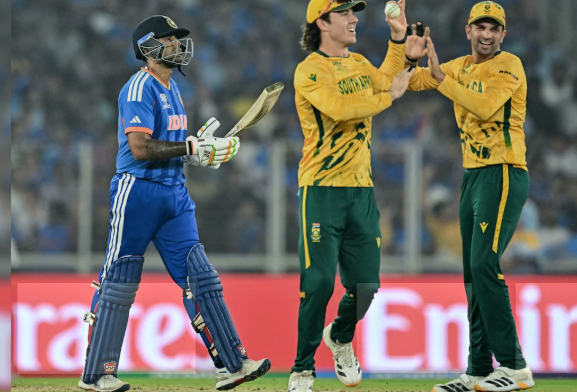
The rivalry between the India National Cricket Team and the South Africa National Cricket Team has grown into one of the most compelling stories in modern cricket. What began in the early 1990s as a clash between a returning South African side and an evolving Indian team quickly turned into a battle of contrasting styles. South Africa brought pace, aggression, and discipline, while India responded with spin, technique, and resilience. Over the decades, this rivalry has produced iconic matches, unforgettable performances, and shifting momentum that reflects the evolution of both teams across formats and generations.
Recent: India vs South Africa
Date
Format
Match Context
Venue
Result
Key Highlight
Feb 22, 2026
T20I
T20 World Cup (S8)
Ahmedabad
SA Won (76 Runs)
David Miller’s explosive 63 (35)
Dec 19, 2025
T20I
5th T20I (Series)
Ahmedabad
IND Won (30 Runs)
Hardik Pandya’s all-round show
Dec 09, 2025
T20I
1st T20I (Series)
Cuttack
IND Won (101 Runs)
SA bundled out for just 74
Dec 06, 2025
ODI
3rd ODI (Series)
Visakhapatnam
IND Won (9 Wkts)
Yashasvi Jaiswal’s clinical 100
Nov 22-26, 2025
Test
2nd Test (Series)
Guwahati
SA Won (408 Runs)
SA historic 2-0 series whitewash
Nov 14-18, 2025
Test
1st Test (Series)
Kolkata
SA Won (30 Runs)
Simon Harmer’s 6-wicket haul
June 29, 2024
T20I
T20 World Cup Final
Barbados
IND Won (7 Runs)
India Crowned World Champions
Top 5 Best Individual Performances
Player Name
Date
Format
Match Context
Performance Summary
Virat Kohli
June 29, 2024
T20I
T20 WC Final
76 (59) — Player of the Match
Simon Harmer
Nov 18, 2025
Test
1st Test (Kolkata)
6/37 — Spin masterclass on Indian soil
Hardik Pandya
Dec 19, 2025
T20I
5th T20I (Series)
42 (18) & 2/15 — The Ultimate Finisher
Heinrich Klaasen
June 29, 2024
T20I
T20 WC Final
52 (27) — Fastest fifty in a WC Final
Yashasvi Jaiswal
Dec 06, 2025
ODI
3rd ODI (Series)
114* (94) — Unstoppable opening knock
Best Player Analysis
Player Name
Primary Role
Recent Major Feat
Impact Rating
Key Contribution
Jasprit Bumrah
Strike Bowler
T20 WC Player of Tourney
9.9 / 10
The world’s most economical death bowler.
Heinrich Klaasen
Wicketkeeper-Bat
Highest SR vs Spin
9.7 / 10
The most dangerous middle-order threat.
Hardik Pandya
All-rounder
Clutch Death Bowling
9.6 / 10
Sealed the World Cup win for India.
Aiden Markram
Captain/Batter
Led SA to first WC Final
9.4 / 10
Stabilized the Proteas through transition.
Kuldeep Yadav
Wrist Spinner
5/17 in Dec 2025
9.3 / 10
Consistently baffles SA middle order.
David Miller
Finisher
Match-winner in 2026 WC
9.2 / 10
The “Killer Miller” still dominates T20s.
Head-to-Head Summary
Format
Matches Played
India Won
South Africa Won
Current Dominance
Test Cricket
2
0
2
South Africa won historic 2-0 series
ODI Cricket
3
2
1
India won the 2025 Home Series (2-1)
T20 International
6
4
2
India won the 2024 World Cup Final
When Two Worlds First Collided on the Cricket Field
The early encounters between India and South Africa were not just cricket matches, they were cultural collisions on the pitch. South Africa returned to international cricket in the early 1990s, and almost instantly, India found itself facing a new kind of challenge: raw pace, disciplined aggression, and relentless fielding intensity. Their first meetings showed a clear contrast. South Africa played fearless, structured cricket, while India relied heavily on experience and spin control. The early scorecards reflected this gap, with South Africa often dominating key sessions. Yet, even in defeat, India showed sparks of resistance that hinted at a future rivalry far more balanced than the early years suggested.
Season
Match Type
Winning Team
Score (India vs SA)
Key Performance
1991-92
ODI Series
South Africa
India 186/10 vs SA 190/4
Allan Donald pace dominance
1992 WC
ODI Match
South Africa
India 177/7 vs SA 171/3 (D/L style)
Kepler Wessels steady batting
1992-93
ODI Series
South Africa
India 165/10 vs SA 168/5
Hansie Cronje all-round control
1996 Tour
ODI Series
South Africa
India 201/8 vs SA 205/6
Jonty Rhodes finishing impact
India’s Struggle in South African Conditions
India’s early tours to South Africa exposed a harsh reality of fast, bouncy pitches and relentless pace attacks. The Indian batting lineup, more comfortable on slower subcontinent tracks, often found it difficult to adjust to extra bounce and seam movement. From the 1992-93 tour onwards, collapses became a recurring pattern, especially in the first innings. South African pacers like Allan Donald, Shaun Pollock, and later Makhaya Ntini exploited every weakness with precision. Even experienced Indian batters struggled to build long partnerships under pressure. Despite occasional resistance from players like Sachin Tendulkar and Rahul Dravid, India’s record reflected dominance by the hosts. These tours became learning phases that eventually shaped India’s modern overseas adaptability and tactical maturity in challenging overseas conditions.
Season
Venue
Result
India Score Pattern
Key Performance
1992-93
South Africa Tour
South Africa won ODI series
Frequent collapses under 200
Allan Donald pace dominance
1996-97
South Africa Tour
South Africa series win
Struggled to cross 180–200
Shaun Pollock consistency
2001-02
South Africa Tour
SA dominant in Tests & ODIs
Inconsistent batting displays
Makhaya Ntini breakthrough spells
2006-07
South Africa Tour
South Africa edged series
Slight improvement but losses continued
AB de Villiers impact performances
The Rise of New Indian Confidence Abroad
As Indian cricket entered the 2000s, a noticeable shift began to emerge in overseas performances, especially in South Africa. The earlier fear of bounce and pace started fading as a technically stronger generation took charge. Rahul Dravid’s resilience, Sachin Tendulkar’s adaptability, and Sourav Ganguly’s fearless leadership changed India’s approach abroad. Instead of survival, India began to compete session by session. The batting unit focused on building partnerships rather than individual heroics. Even in tough South African conditions, India started posting competitive totals and occasionally winning crucial sessions. Though victories were still rare, the mindset transformation was clear. India was no longer intimidated, but increasingly prepared to challenge South Africa on their home soil with growing belief and tactical discipline.
Season
Venue
Result
India Score Trend
Key Performance
2001-02
South Africa Tour
South Africa won series
Improved 250+ totals in Tests
Rahul Dravid marathon innings
2006-07
South Africa Tour
South Africa edged series
More competitive batting displays
Sachin Tendulkar consistency
2010-11
South Africa Tour
Drawn/competitive series
Strong partnerships built
VVS Laxman resistance knocks
2013-14
South Africa Tour
South Africa narrow win
India crossed 280+ regularly
Virat Kohli emergence abroad
The ODI Rivalry Heats Up in the 2000s
The 2000s marked a turning point in the India vs South Africa ODI rivalry, where matches shifted from one-sided contests to tightly fought battles. South Africa still held an edge at home, but India’s improved middle order and sharper chasing ability made every game unpredictable. Players like Virender Sehwag, Yuvraj Singh, and MS Dhoni began changing the tempo of matches with aggressive intent. On the other side, South Africa relied heavily on AB de Villiers, Jacques Kallis, and Herschelle Gibbs to control innings with precision. Many matches went deep into the final overs, creating intense pressure situations for both teams. The rivalry was no longer just about conditions, but about execution under pressure and individual brilliance deciding outcomes.
Season
Venue
Result
India Score Trend
Key Performance
2002-03
South Africa
South Africa won series
India 250+ but inconsistent
Gibbs explosive batting
2006
India
India won ODI series
Strong 280+ chases
Yuvraj Singh impact knocks
2007
South Africa
South Africa won series
Mixed totals under pressure
AB de Villiers breakout form
2010
India
India strong performances
Consistent 260+ scores
MS Dhoni finishing ability
World Cup Clashes and Pressure Matches
World Cup meetings between India and South Africa have always carried a different kind of weight. These are not just group stage games or knockout fixtures on paper, they are emotional pressure cookers where reputation, form, and nerves collide. South Africa often entered these clashes with a reputation for being tournament favorites but historically struggled to convert dominance into knockout success. India, on the other hand, carried a reputation for big-match temperament shaped by experience in pressure chases. From the early 1992 encounters to the modern ICC tournaments, these matches have produced dramatic collapses, calm chase finishes, and unforgettable individual performances. Every World Cup clash added another layer to a rivalry built on intensity, tactical battles, and moments where one mistake changed everything.
Year
Venue
Result
Score (IND vs SA)
Key Performance
1992
Australia/SA
South Africa won
IND 177/7 vs SA 171/3 (rain-adjusted era)
Kepler Wessels controlled innings
1999
England
South Africa won
IND 253/5 vs SA 254/3
Jacques Kallis all-round stability
2011
India
India won
IND 296/10 vs SA 290/9
Sachin Tendulkar crucial 111
2015
Australia
South Africa won
IND 307/7 vs SA 308/2
AB de Villiers match-winning 77*
Spin vs Pace Tactical Evolution
The India vs South Africa rivalry has always been shaped by a classic battle of styles, spin against pace. In the early years, South Africa’s fast bowlers dictated terms with steep bounce, seam movement, and relentless aggression. India’s spin attack, though world class at home, often struggled to grip matches on South African surfaces. However, as cricket evolved into the 2000s and beyond, both teams adapted their strategies. India began producing bowlers who could reverse swing the ball and batters who could survive pace-heavy spells. South Africa, meanwhile, developed better spin-hitting techniques and added versatility to their bowling units. This tactical evolution turned the rivalry into a chess match rather than a one-dimensional contest. Conditions still mattered, but execution and adaptability became the true deciding factors.
Season
Venue
Result Trend
Dominant Skill
Key Tactical Shift
1992-93
South Africa
SA dominant
Fast bowling
India struggled vs bounce and seam
2001-02
South Africa
SA strong hold
Pace attack
India began defensive batting approach
2010-11
India
Balanced contests
Spin impact
India used spin control in middle overs
2013-14
South Africa
Competitive series
Mixed attack
India improved pace resistance and partnerships
Recent Era Dominance Shifts
In the most recent phase of the India vs South Africa rivalry, the balance of power has shifted more frequently than ever before. Gone are the days when South Africa could rely on home conditions to assert clear dominance, and India could only hope for isolated breakthroughs. Instead, modern cricket has brought fitness-driven squads, data-based strategies, and fearless batting lineups on both sides. India’s rise as a dominant all-format team has been matched by South Africa’s rebuilding phase, where young talent has been tested under pressure. The result is a rivalry that now swings based on form, execution, and adaptability rather than historical advantage. India has started winning more consistently in ICC events and bilateral series, while South Africa continues to produce match-winners capable of changing games in a single spell or innings.
Season
Venue
Result Trend
India Score Pattern
Key Performance
2015-16
South Africa
Closely fought series
India 260–300 totals
Virat Kohli consistent batting
2017-18
South Africa
Competitive series
India improved overseas scoring
Bhuvneshwar Kumar swing impact
2020-21
South Africa
India competitive edge
Balanced totals under pressure
Jasprit Bumrah bowling control
2022-24
Multi-series
India stronger overall
Higher chase success rate
Shreyas Iyer, KL Rahul contributions
Conclusion
The India vs South Africa rivalry stands today as a symbol of cricketing evolution and mutual respect. From early mismatches to modern-day thrillers, both teams have pushed each other to improve in every department of the game. Conditions, formats, and eras have changed, but the intensity has remained constant. Whether it is ICC tournaments or bilateral series, this rivalry continues to deliver high-pressure moments and unforgettable cricket. It is no longer just about winning matches, but about shaping legacies, defining careers, and showcasing the finest balance of skill and temperament in world cricket.